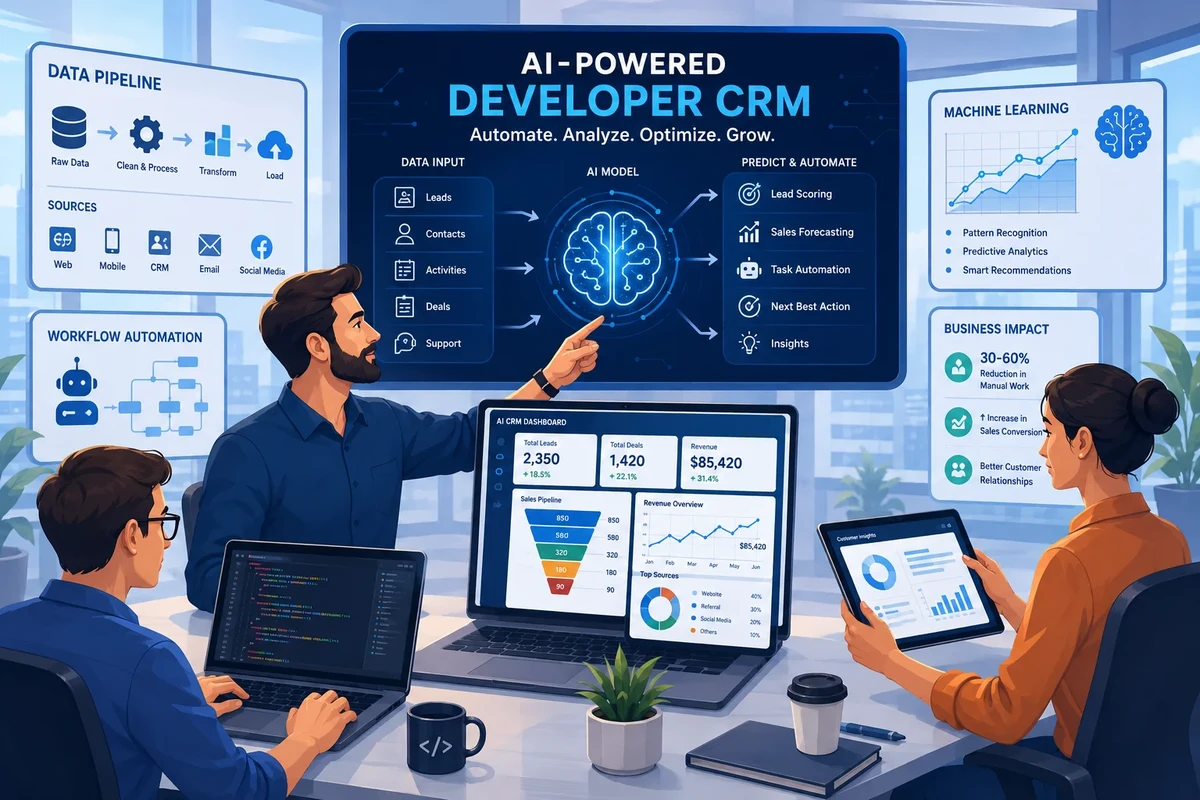
By 2026, AI-powered CRM is transitioning from passive conversational copilots to autonomous multi-agent networks that execute cross-functional revenue workflows without manual intervention. Rather than merely summarizing emails, modern CRM engines coordinate lead qualification, dynamic deal routing, and customer retention by operating directly across unified enterprise data architectures.
Data from Creatio reveals that 86% of C-level decision-makers report AI agents will be vital to strategic goals over the next two to three years, driving an AI-CRM market projected to reach $128 billion by 2028 with a 28% compound annual growth rate. Revenue operations leaders now face a fundamental architectural transition: moving past isolated prompt-and-response interfaces toward autonomous execution layers capable of managing pipeline health, contractual risk, and client interactions across distributed corporate data stacks.
How Does Agentic CRM Differ from Legacy Tools?
In 2026, AI-powered CRM shifts from isolated conversational copilots to autonomous multi-agent systems. Rather than waiting for manual prompts to summarize text, autonomous CRM agents independently interpret customer intent, hand off tasks across sales and customer support pipelines, and execute complex revenue workflows without continuous human supervision.
This operational shift marks the transition across three distinct eras of customer relationship software. CRM 1.0 functioned primarily as a passive digital rolodex and contact log, requiring sales representatives to manually input every record and interaction. CRM 2.0 introduced rule-based workflow automation, triggering deterministic if-then sequences based on static form fills or explicit field changes. In contrast, CRM 3.0 introduces autonomous agentic intelligence, where software agents independently parse messy conversational context, determine downstream actions, and execute operational workflows across enterprise applications.
In legacy copilot environments, a sales representative relied on an embedded chat interface to draft individual outreach messages or extract contact details after a phone call. The human operator remained the cognitive glue holding disparate business functions together. Agentic CRM architectures replace this manual coordination with multi-agent orchestration. A specialized inbound triage agent analyzes incoming behavioral signals, transfers high-priority enterprise prospects to an automated scheduling agent, alerts revenue operations of contract anomalies, and provisions customer success agents with onboarding data without manual human prompts.
Enterprise software leaders emphasize that this shift alters core competitive dynamics. As Burley Kawasaki, Global VP of Product Marketing and Strategy at Creatio, observed:
“Agentic automation is not simply another technology trend. It is the foundation of how enterprises will innovate, compete, and grow in the AI Economy.”
By delegating multi-step task resolution to specialized autonomous agents, enterprise revenue teams remove the latency inherent in manual handoffs between marketing qualification, account executive engagement, and customer support.
Why Architecture Dictates AI Performance Across Revenue Teams
Algorithmic accuracy in customer relationship management depends entirely on foundational data architecture rather than front-end interface features. Deploying sophisticated natural language models on top of fragmented, departmental databases creates isolated operational silos, resulting in flawed lead prioritization and contradictory customer communications.
Enterprise workflow consultancy Symantra highlighted this structural stagnation directly:
“Let’s be honest: most CRMs haven’t changed much in a decade. They’re slow, siloed, and rarely deliver useful insights. Meanwhile, customers move faster, expect more, and leave sooner.”
Gartner projects that 80% of generative AI business applications will be developed on existing data management platforms by 2028. This projection highlights why point solutions fail to deliver sustained revenue gains: when an artificial intelligence engine lacks visibility into real-time operational records, such as enterprise resource planning, financial ledgers, product usage logs, and customer support tickets, its automated actions lack business context. An autonomous agent that promises delivery timelines without querying supply-chain databases or offers contract renewal discounts without reviewing financial payment histories creates severe operational liabilities.
High-performing revenue organizations deploy a structured three-phase methodology to transition from disconnected databases to autonomous intelligence:
- Phase 1: Enterprise Stack and Pipeline Audit: Revenue operations teams catalog all existing customer touchpoints, structured transaction records, unstructured communication histories, and operational databases to establish data provenance and eliminate dark data silos.
- Phase 2: Connective Data Fabric Deployment: Engineering teams implement unified data pipelines, bidirectional synchronization protocols, and vector index architectures that connect the CRM to enterprise-wide billing, support, and resource planning platforms.
- Phase 3: Compounding Intelligence and Autonomous Execution: Technical leaders deploy closed-loop multi-agent networks that continuously analyze operational telemetry, refining account scoring, churn risk predictions, and deal-routing rules based on observed customer outcomes.
Quantifying Enterprise ROI: Real Gains from Early Deployments
Deploying AI in enterprise CRM drives measurable performance improvements: organizations experience a 29% average increase in sales, a 15-20% boost in customer satisfaction, and up to 60% operational cost reductions. High-performing deployments shorten sales cycles by 25% and reduce support call handling time by 30% through automated processing.
Enterprise revenue leaders shifting from speculative pilots to balance-sheet accountability require validated deployment metrics. Empirical performance data gathered across global corporate implementations and industry research benchmarks demonstrates that integrated AI CRM deployments yield compounding efficiency gains across pipeline velocity, support overhead, and representative output.
Metric / Impact Area |
McKinsey Industry Benchmark |
XYZ Corp Case Study Result |
Bouygues Telecom Deployment |
|---|---|---|---|
Lead Conversion & Generation |
Potential lead increase exceeding 50% |
40% increase in lead conversion rates |
Dynamic routing of inbound customer requests |
Sales Cycle Velocity |
Measurable pipeline cycle compression |
25% shortening of sales cycles |
Accelerated commercial account qualification |
Operating Costs & Admin Time |
Up to 60% operational cost reduction |
65% reduction in manual data entry |
Automated interaction logging and transcription |
Customer Retention & Experience |
15-20% customer satisfaction lift; 5-8% revenue gain |
30% decrease in customer churn |
Real-time issue resolution across contact channels |
Contact Center Handle Time |
Up to 70% call time reduction potential |
Automated post-call CRM record generation |
30% faster support call handle time |
Overall Financial Return |
Scaled margin expansion across revenue operations |
5x ROI exceeding $2 million annually |
Millions of dollars saved in operating overhead |
The comparative data illustrates a clear operational divergence: organizations deploying unified AI systems achieve substantial operating efficiency, whereas organizations layering isolated tools onto fractured databases report negligible margin improvement.
Sales Pipeline Velocity and Churn Mitigation
Operational data from enterprise case studies reveals how automated administrative relief translates into tangible commercial growth. At XYZ Corp, deploying an AI CRM system drove a 65% reduction in manual data entry for sales representatives. Eliminating repetitive logging allowed account executives to dedicate their working hours to high-value client engagements, resulting in a 40% increase in lead conversion rates and a 25% shortening of sales cycles.
Simultaneously, XYZ Corp achieved a 30% reduction in customer churn by utilizing automated health scoring to identify accounts showing declining interaction frequency. Over twelve months, these operational gains generated a 5x return on investment, exceeding $2 million in net financial returns. These outcomes align directly with research from McKinsey & Company, which documents that using artificial intelligence to proactively deliver customer interactions at the right time increases enterprise revenue by 5-8% and raises customer satisfaction scores by 15-20%.
Contact Center Handle Times and Support Savings
Customer service and support workflows exhibit immediate operational returns when integrated with generative summarization models. Telecommunications company Bouygues Telecom deployed generative AI CRM capabilities developed with IBM to process and summarize customer support calls. By automatically synthesizing spoken conversations and updating CRM customer profiles in real time, the organization achieved a 30% reduction in support call handle times and generated millions of dollars in operational savings.
Across the broader enterprise landscape, research compiled by McKinsey indicates that implementing AI in CRM systems has the potential to increase total leads by more than 50%, reduce operational costs by up to 60%, and decrease customer call durations by up to 70%. Aggregate industry studies confirm that companies deploying AI CRM solutions report an average 29% increase in sales and a 34% improvement in customer service delivery.
Comparing Platform Strategies Across Leading Ecosystems
Selecting an enterprise CRM strategy in 2026 requires revenue architects to evaluate foundational platform engineering rather than feature lists. Modern solutions diverge across distinct approaches: integrated enterprise application suites, relationship-centric platforms, predictive workspace environments, and composable open-architecture data stacks.
- Enterprise Agentic Frameworks (Salesforce, Creatio): Salesforce utilizes its Einstein AI and Agentforce architecture to deploy autonomous agents that execute multi-step business logic across enterprise sales and service clouds. Creatio pairs a no-code design interface with autonomous AI agents, allowing operational teams to configure governance parameters, define multi-agent task routing, and automate revenue operations without writing custom code.
- Intelligent Omnichannel Ecosystems (Zoho Zia): Zoho embeds its Zia intelligence engine across an interconnected suite of business tools, executing automated actions across separate business applications from plain-language prompts. A sales operations director can configure automated rules using natural language prompts, such as:
“When a high-value lead downloads our pricing guide, notify the sales director and create a task for follow-up within 2 hours.”
In response, Zia evaluates historical conversion data and surfaces operational recommendations, noting:
“Leads from this industry typically convert faster when contacted within 30 minutes rather than 2 hours.”
- Predictive Revenue Workspaces (monday CRM): monday CRM integrates predictive revenue intelligence and autonomous agents directly into visual execution boards. By aligning dynamic content generation with real-time lead score calculations, the platform updates account prioritization dynamically. As Daniel Saks, Chief Executive Officer at Landbase, documented in analyses of modern lead scoring frameworks, bidirectional data synchronization ensures machine learning models recalculate pipeline priorities whenever prospective buyer behavior indicates commercial intent.
- Relationship-First Intelligence Platforms (Rings AI): Rings AI focuses on client prospecting, automated interaction tracking, and real-time business news monitoring. Rather than requiring representatives to manually record contacts, the platform maps existing professional networks to identify warm introduction paths across shared connections, bypassing cold outreach channels.
These architectural models introduce fundamental shifts in enterprise software budgeting. Walled-garden platforms provide pre-configured security guardrails but transition corporate costs from predictable per-seat monthly subscriptions toward consumption-based pricing models based on token usage or task resolutions. Conversely, composable architectures that integrate open-weight language models over self-hosted databases offer complete data sovereignty and fixed compute overhead, but require internal engineering teams to maintain orchestration layers and integration pipelines.
The Pre-Deployment Data and Governance Audit Checklist
Connecting autonomous revenue agents to unvetted legacy CRM databases introduces critical technical and legal vulnerabilities. Stale account data, duplicated contact records, and orphaned deal stages corrupt Retrieval-Augmented Generation (RAG) pipelines, causing autonomous agents to hallucinate non-existent pricing tiers, misinterpret buying signals, or trigger unauthorized customer communications.
Operational Risk Warning: Autonomous outbound agents operating without deterministic guardrails risk catastrophic failure modes, including unauthorized discounting, binding contract promises made on outdated pricing schedules, and simultaneous outreach from concurrent agents that alienates target accounts. Revenue teams must establish human-in-the-loop intervention thresholds for commercial commitments exceeding defined risk limits.
Full-Stack Data Asset Discovery and Hygiene
To eliminate data poisoning and prevent agent hallucinations, enterprise engineering teams must complete a five-tier pre-deployment audit across all operational systems before deploying autonomous workflows:
- Core Source Systems and Pipeline Records: De-duplicate company accounts, sanitize contact properties, merge split client histories, and archive orphaned opportunities across legacy databases.
- Unstructured Communication Repositories: Sanitize customer email archives, recorded sales calls, and chat transcripts; redact proprietary client secrets, personal identifiers, and unverified verbal promises before data ingestion.
- Vector Embeddings and Knowledge Indexes: Verify semantic search index hygiene, implement chunking boundaries that preserve contractual context, and enforce automated time-to-live policies to purge deprecated product catalogs and retired rate sheets.
- Prompt Logs and Multi-Agent Interaction Histories: Establish immutable audit trails that capture agent-to-agent delegation commands, inbound prompt parameters, model response payloads, and downstream database write operations.
- Model Checkpoints and Algorithmic Guardrails: Audit baseline model weights, validate custom fine-tuning datasets against biased outcomes, and implement deterministic rule checks that intercept unauthorized discounts or commitments before external transmission.
Statutory Compliance and Algorithmic Bias Safeguards
Conducting a data discovery audit limited solely to standard CRM database tables fails statutory data subject rights requests under modern privacy legislation. Because enterprise AI systems ingest customer information into semantic vectors, prompt caches, and fine-tuning datasets, an organization that searches only structured CRM fields cannot fulfill statutory access, correction, or deletion requests.
Global regulatory frameworks have enacted strict compliance mandates for autonomous business software:
- South Korea AI Basic Act: In effect since January 22, 2026, this statute establishes legal duties for organizations deploying high-impact and generative AI systems, including mandatory advance notice to users and clear labeling of all AI-generated content in customer-facing commercial environments.
- European Union AI Act Enforcement: Prohibited AI practices became legally applicable across the EU on February 2, 2025, followed by obligations for general-purpose AI models on August 2, 2025.
- Regulation (EU) 2026/1744 (Digital Omnibus on AI): Entering into force on July 27, 2026, this regulation adjusted compliance schedules, establishing December 2, 2027, as the enforcement date for Annex III high-risk AI system requirements.
Revenue leaders using automated lead scoring, candidate screening, or dynamic customer profiling must maintain explainable audit trails. Regulators require proof that automated ranking models do not exhibit demographic bias or discriminatory exclusion during commercial lead qualification.
What Should Operational Leaders Prioritize for 2026?
Enterprise artificial intelligence adoption has passed the phase of speculative experimentation. Revenue operations leaders in 2026 evaluate CRM modernization through unit economics, employee productivity, and measurable margin impact rather than software novelty. Commercial success is defined by time saved, operating cost reductions, and verifiable pipeline growth.
Industry-specific AI models represent a major growth vector for enterprise revenue teams. Projections indicate the market for vertical-specific AI agents will grow by 35% over the next five years. Tailored domain models are replacing generic foundation models, providing specialized workflows for financial services compliance, healthcare patient retention tracking, and real estate pricing optimization without requiring custom development from scratch.
Simultaneously, mobile-first architectures incorporating on-device Small Language Models (SLMs) empower field sales teams to record client discussions and process meeting notes locally. By executing inference directly on mobile hardware without streaming confidential client audio across public cloud infrastructure, field representatives maintain enterprise data privacy standards while automating operational logging.
RevOps directors preparing their technology stacks must prioritize data hygiene, establish human-in-the-loop guardrails for commercial commitments, and align software budgets with consumption-based economics to build sustainable revenue engines.
FAQ
How will AI agent pricing disrupt traditional per-seat CRM licensing in 2026?
Enterprise procurement is moving away from per-user seat subscriptions toward consumption and resolution-based monetization. As autonomous agents handle routine qualification and support workflows without human seats, revenue leaders structure software budgets around task volume, compute tokens, and verified business outcomes rather than employee headcounts.
How do enterprises prevent catastrophic hallucinations in autonomous outbound CRM agents?
Enterprises enforce strict deterministic guardrails and human-in-the-loop intervention protocols. System architects limit autonomous agent decision-making boundaries regarding commercial pricing, establish mandatory human authorization triggers for binding contractual concessions or discounts, and log multi-agent interactions to prevent conflicting simultaneous customer outreach.
Why do enterprise RAG deployments fail when connected to legacy CRM databases?
Retrieval-Augmented Generation fails in legacy systems when semantic indexes ingest duplicated account records, orphaned pipeline stages, and uncurated sales email threads. Without rigorous pre-deployment data sanitation, AI models retrieve outdated context, generating inaccurate revenue forecasts and hallucinated account timelines that damage customer relationships.
How does the EU AI Act impact automated lead scoring and CRM workflows?
Under Regulation (EU) 2026/1744 and established EU AI Act governance provisions, automated customer profiling and lead qualification systems face rigorous explainability mandates. Revenue organizations must maintain auditable data inventories across prompt logs, vector stores, and model checkpoints to demonstrate algorithmic fairness and eliminate discriminatory bias.